


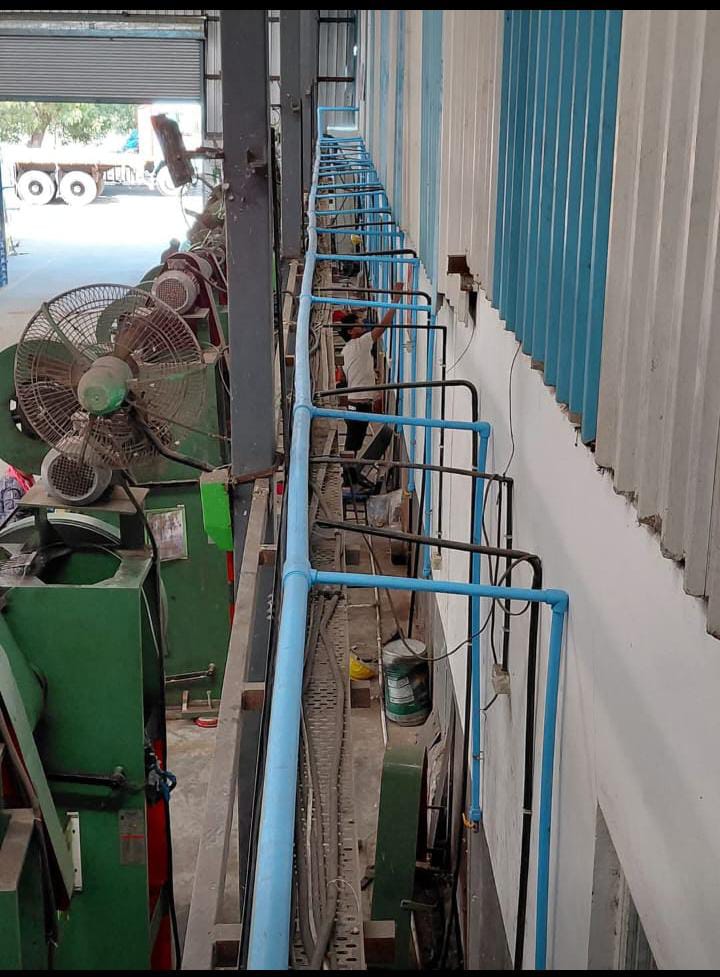
setting up air piping for an LG compressor using PPR (Polypropylene Random Copolymer), you're making a smart move for corrosion resistance, but there are some critical "rules of the road" to ensure the system doesn't fail under pressure or heat.
Here is a guide to doing it right.
1. Why PPR?
PPR is becoming a favorite for compressed air because:
Zero Corrosion: Unlike iron pipes, PPR won't rust, meaning your LG compressor’s downstream tools and valves stay clean.
Lower Pressure Drop: The smooth interior surface reduces friction.
Leak-Proof: Heat-fused joints are effectively one continuous piece of plastic.
2. The Critical "Heat" Warning
LG rotary and piston compressors can discharge air at temperatures exceeding 70°C to 90°C if not properly cooled.
Standard PPR is rated for high pressure at ambient temperatures (20°C), but its strength drops significantly as temperature rises.
Requirement: You must use PPR-AL-PPR (multilayer pipe with an aluminum core) or ensure you have a heavy-duty aftercooler or a length of metal piping (at least 2–5 meters) between the compressor pump and the start of the PPR line to dissipate heat.
3. Installation Best Practices
The "Loop" System
For a shop or factory setup, install the piping in a closed loop. This allows air to reach a tool from two directions, balancing the pressure and reducing the load on the compressor.
Drainage and Pitch
Slope: Pitch your horizontal lines 1% away from the compressor.
Drop Legs: Always take your tool outlets from the top of the main line (using a "gooseneck" or "T" facing up) to prevent liquid water from entering your tools.
Pipe Sizing
Don't bottleneck your LG compressor.
For a small 2HP–5HP unit, 25mm PPR is usually sufficient.
For larger industrial LG units, move to 32mm or 40mm to maintain flow volume.
4. Pressure Rating Check
Ensure you are using PN20 or PN25 rated PPR.
PN20 is rated for 20 bar at 20°C.
Since most LG shop compressors run at 8–10 bar, PN20 provides a safe 2:1 safety margin, provided the air is kept cool.


