


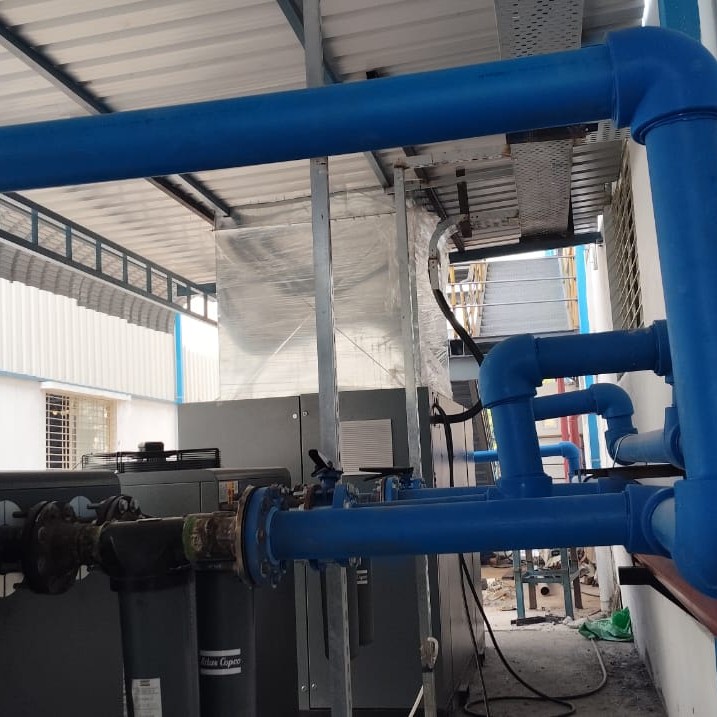
Indutility Engineers Pvt. Ltd. provides specialized industrial and commercial utility solutions, focusing on the design and execution of PPR (Polypropylene Random Copolymer) piping systems for compressed air, HVAC, and industrial fluid transport.
The installation of PPR pipes in an industrial setting requires a high level of technical precision to ensure the system handles high pressure and thermal expansion.
1. Key Installation Stages
In an industrial environment, the installation follows a rigorous engineering process to ensure leak-proof performance and durability.
Preparation & Inspection
Quality Check: Before installation, pipes are inspected for bubbles, cracks, or grooves. Ends must be clean and cut perpendicular to the pipe axis.
Tool Calibration: Welding machines (fusion tools) must be calibrated to a constant temperature of 260°C.
The Socket Fusion Process
This is the standard method for joining PPR. Unlike traditional plumbing, industrial joints must be perfectly homogeneous to handle vibration and pressure surges.
Heating: The pipe and fitting are inserted into the heating bushes simultaneously.
Joining: Once the heating time (based on pipe diameter) is reached, they are joined immediately without twisting.
Cooling: The joint must remain undisturbed for a set cooling period to ensure the molecular bond is fully set.
2. Industrial Design Considerations
Indutility Engineers typically incorporate the following engineering standards for industrial layouts:
Linear Expansion Management
PPR has a higher thermal expansion coefficient than metal. For long industrial runs:
Expansion Loops: L-shaped or Z-shaped bends are designed to allow the pipe to move without stressing the joints.
Supports: A mix of Fixed Supports (to direct movement) and Sliding Supports (to allow longitudinal expansion) are installed.
Pressure & Temperature Ratings
Industrial systems are categorized by their PN (Nominal Pressure) rating:
PN16/PN20: Standard for industrial hot and cold water.
PN25: Used for high-pressure systems or specialized chemical transport.
Temperature: Systems are often rated for continuous use up to 70°C, with short-term peaks up to 95°C.
3. Testing and Compliance
Post-installation, Indutility Engineers follow strict testing protocols to validate the integrity of the system:
Hydrostatic Pressure Test: * Cold Water: Tested at 1.5 times the working pressure (minimum 1.0 MPa).
Hot Water: Tested at 2.0 times the working pressure (minimum 1.5 MPa).
Stabilization: The pressure is held for at least 1 hour. A pressure drop of more than 0.05 MPa indicates a potential leak or improper fusion joint.
Standards: Installations generally comply with DIN 8077/8078 or ISO 15874 for plastic piping systems.


